

In 1863, a man named Byrne walked down a street past a flour warehouse in Liverpool. A barrel rolled out of an upper window and landed on him. He could not name the worker who dropped it, and he could not explain how it got loose. The judge let him win anyway, and that ruling built a doctrine American courts still apply today. More from us: Implied Consent.
The short answer: res ipsa loquitur lets an injured person prove negligence from the circumstances alone, with no direct evidence of what the defendant did wrong. If the accident is the kind that does not happen without carelessness, and the defendant controlled the thing that caused it, a jury may find negligence.
Chief Baron Pollock put it. Barrels of flour do not fly out of warehouse windows on their own. Somebody in that warehouse was careless, and Byrne had no way to see inside it. Forcing him to name the careless worker would have handed the warehouse a free pass for the very secrecy that caused his problem.
That logic drives res ipsa loquitur now. It shows up most often in cases handled by personal injury lawyers. The injured person was unconscious, outside the building, or otherwise in no position to watch what went wrong.
Key takeaways
- Circumstantial evidence becomes proof of negligence under this doctrine, even when direct proof is out of reach.
- Three elements control it: an accident that implies carelessness, a defendant who controlled the cause, and a plaintiff who did not cause it.
- Most states treat the result as an inference a jury may accept or reject, not a presumption the defendant must disprove.
- Winning on it usually means reaching a jury, not winning the case outright.
- The element defendants attack hardest is control, because shared control often sinks the argument.
The three elements and what each one requires

Courts phrase the test slightly differently by state, but the substance holds steady. The table below breaks each element into what a plaintiff has to put in front of the judge.
| Element | What it means | What you must show | Where it fails |
|---|---|---|---|
| 1. The accident implies negligence | This type of event does not normally happen if everyone is careful | Common experience, or expert testimony where the subject is technical, that careful practice prevents this outcome | Events with innocent explanations, such as a slip on rain tracked in by other customers |
| 2. The defendant controlled the cause | The instrument of harm was in the defendant’s hands, or under a duty the defendant could not hand off | Ownership, custody, maintenance records, or a nondelegable duty over the equipment or the patient | Shared access, public use, or a long gap between the defendant’s last contact and the injury |
| 3. The plaintiff did not contribute | Your own conduct is not a plausible cause of what happened | Evidence that you used the product or premises normally, or that you were unconscious | Misuse, ignored warnings, or conduct a jury could read as the real cause |
Some states have folded the third element into ordinary comparative fault, so a partly careless plaintiff can still argue the doctrine. Check the pattern jury instruction in your own state before assuming which version applies.
Five American cases that show the doctrine at work
Explainers usually stop at the barrel, so the res ipsa case law readers meet is 160 years old. The cases that matter to a modern claim are American, and one of them is a loss.
Escola v. Coca-Cola Bottling Co. (California, 1944)
While moving bottles into a refrigerator, a waitress had one burst in her hand and cut her badly. She could not prove how the bottler had mishandled that bottle. California’s Supreme Court allowed the inference anyway, reasoning that sound bottles handled properly do not explode in a waitress’s hand.
Ybarra v. Spangard (California, 1944)
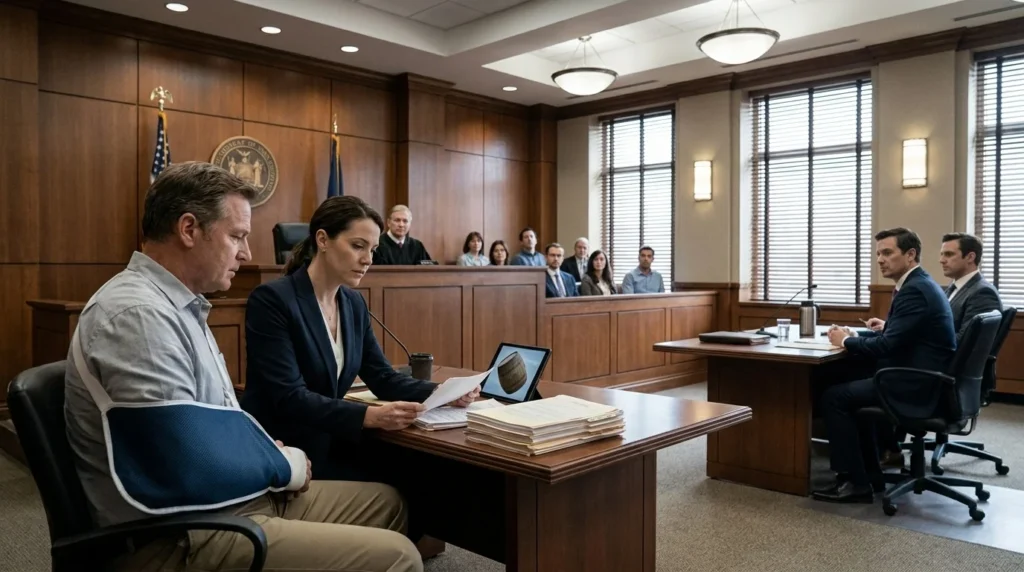
A patient went under anesthesia for an appendectomy and woke with a crippling shoulder injury. He had no idea which doctor, nurse, or orderly did it. Rather than let a room full of defendants hide behind that ignorance, the court applied the doctrine against all of them together.
Larson v. St. Francis Hotel (California, 1948)
This one is the loss, and it teaches more than the wins. During the V-J Day celebrations, an armchair fell from a window of the St. Francis Hotel and knocked a woman on the sidewalk unconscious. She argued the accident spoke for itself. The court disagreed, because guests, not the hotel, controlled the furniture inside their own rooms. Shared control killed the claim.
Colmenares Vivas v. Sun Alliance Insurance Co. (First Circuit, 1986)
At a Puerto Rico airport, an escalator handrail stopped moving while the steps kept climbing, and a passenger fell. Sun Alliance argued that a maintenance contractor, not the airport authority, controlled the escalator. Judges held that the duty to keep it safe could not be handed off, so control stayed with the authority.
Kambat v. St. Francis Hospital (New York, 1997)
An 18 by 18 inch surgical pad turned up inside a patient’s abdomen months after a hysterectomy, and she later died of related infection. New York’s highest court held the jury should have been told about the doctrine. A pad that size does not end up inside a patient when a surgical team counts carefully.
Does res ipsa loquitur apply in medical malpractice?

Yes, though narrowly. Courts split these cases into two groups. Where a lay juror can judge the mistake from ordinary experience, no expert is needed. A sponge left inside a body, surgery on the wrong knee, or a burn on a part of the body nobody operated on can all support res ipsa loquitur.
Everything else requires an expert. If you argue that a surgeon misread a scan or chose the wrong medication dose, a juror has no common experience to draw on. Your expert then supplies the first element by testifying that this result does not follow careful practice.
That same split shows up in cases brought by a nursing home abuse attorney, where a resident with dementia cannot describe how a fracture happened. Some injuries speak plainly. Others need a physician to explain why the facility’s account does not add up.
What the doctrine actually buys you in court
This is the part most articles get wrong. They call the result a presumption, which suggests the defendant now has to prove innocence. In most states, and clearly in New York, it is weaker than that.
New York’s Unified Court System publishes the Guide to New York Evidence. According to its Rule 3.02, a jury “may, but is not required to,” draw the inference of negligence. That rule cites Morejon v. Rais Construction Co., decided in 2006. Only in the rarest cases, Morejon held, may a plaintiff win summary judgment on the doctrine.
So the practical value is survival. The doctrine stops a judge from throwing your case out for lack of direct proof, and it puts the question to twelve people instead.
That matters more than it sounds. Most negligence claims resolve before trial, and an insurer negotiates very differently once a judge has ruled the case can reach a jury.
How defendants beat a res ipsa argument

Defense attorneys rarely attack all three res ipsa elements at once. They pick the weak one and stay on it.
- Attack control. Larson is the template. If anyone else could have touched the hazard, the defense builds the case around that access.
- Offer an innocent cause—a power surge, a manufacturing defect upstream, a third party’s sabotage. The alternative does not have to be proven, only made plausible.
- Blame the plaintiff. Store video showing you running or looking at your phone reframes the whole event, which is why a slip-and-fall lawyer asks for surveillance footage immediately.
- Show careful practice. Maintenance logs, inspection records, and staff testimony do not automatically defeat the inference, but they give a jury a reason to decline it.
What to do next
If you were hurt and nobody can tell you how, that gap is not the end of your claim. Write down what you remember while it is fresh, photograph the scene and equipment, and ask for the maintenance or surgical records before they age out of retention. Then take everything to a personal injury attorney licensed in your state, who can determine whether your facts support res ipsa loquitur under the doctrine your courts actually apply.
FAQs
No. It removes an obstacle rather than deciding the case. The jury can hear the whole argument, believe the defendant, and still return a defense verdict.
Most states, including New York, call it a permissible inference. A minority shift some burden onto the defendant. Your state’s pattern jury instruction is the place to check.
Yes. The doctrine addresses breach of duty only. Causation and the value of your injuries are still your burden, with medical records and bills.
Occasionally. A parked car that rolls downhill or a wheel that comes off a truck fits the pattern well. A collision with two moving drivers usually does not, because neither one had exclusive control.
The same deadline as any negligence claim in your state, commonly two or three years from the injury. Medical claims often run on shorter or differently measured clocks.