

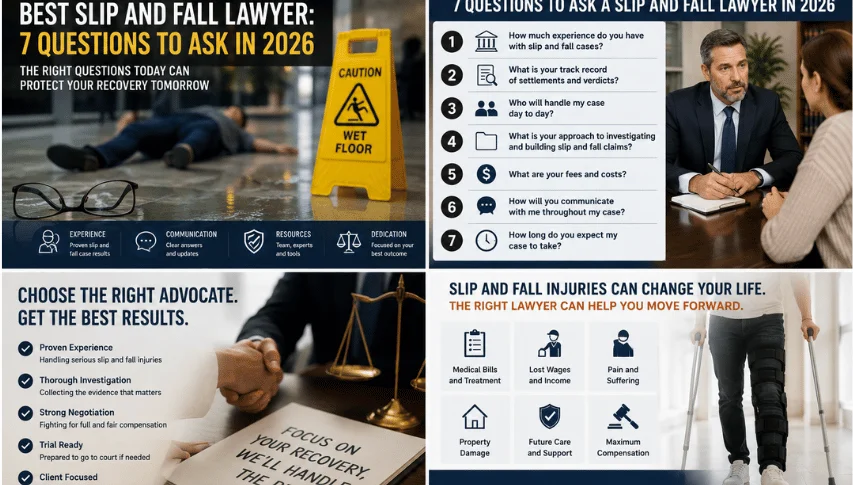
Every injury firm in the country will tell you it is the right choice. The best slip and fall lawyer for your case is the one whose fee terms, caseload, and courtroom record match what happened to you. You can check all three in one phone call. This guide shows you how. There is more on this in Car Accident Attorneys.
Hiring is a comparison problem, not a popularity contest. Below you get a table of the four kinds of firms that take these cases. You also get the fee math that decides your net check. Then come the seven questions that separate the best slip-and-fall lawyer from a call center with a law license.
The short answer: which firm fits which case
Pick a firm by fit, not by billboard. A solo practitioner suits a clear fall with modest medical bills. Regional injury firms handle disputed claims against chain stores well. A trial boutique fits a severe injury where the store denies fault. All four types work on contingency, so compare the terms.
Four kinds of firm, compared
The differences that matter never appear on the homepage. They sit in the fee agreement, the caseload per attorney, and whether the office has taken a premises case to verdict recently. The percentages below reflect what US injury firms commonly quote in 2026. Your state shapes the odds too, through its own premises liability rules and negligence standards.
| Firm type | Typical contingency fee | Who works your file | Trial record | Best fit |
|---|---|---|---|---|
| Solo practitioner | 33% before suit | The attorney you met | Rare; settles almost everything | Admitted hazard, bills under $25,000 |
| Regional injury firm | 33% rising to 40% | Case manager, attorney reviews | Some verdicts each year | Grocery and chain store falls, disputed notice |
| National advertising firm | 33% to 40%, may pay referral fees | Intake staff, often a partner firm | Thin-volume settlements | Simple claims you want off your desk |
| Trial boutique | 40% once suit is filed | A named partner | Regular jury trials | Surgery, contested fault, six figures and up |
Key takeaways
- Contingency fee tiers usually start at 33% and rise to 40% once a lawsuit is filed.
- Ask whether the fee comes off the gross settlement or off the money left after costs.
- Find out who pays case costs if you lose and whether the firm advances expert fees.
- Medical liens and health insurance subrogation can take a bigger bite than the fee.
- Surveillance video gets overwritten in days, so the hiring decision is time-sensitive.
What the best slip and fall lawyer charges, and what you keep

Almost every firm takes these cases on contingency. No win, no fee.
The percentage is rarely one flat number, though, and the trigger that moves it up belongs in your notes.
- 33% if the claim settles before anyone files a lawsuit.
- 40% once the firm files suit and discovery begins.
- 40% to 45% on appeal in some states, written into the same agreement.
Run the math on a real number. Say your case settles for $90,000 after suit is filed. A 40% fee is $36,000; case costs of $6,000 come off next, and a $12,000 health insurance lien follows. Your check is $36,000.
Now change one word in the contract. If the fee is calculated after costs rather than on the gross settlement, the fee drops to $33,600, and you keep about $2,400 more. Same case, same firm, different paragraph.
Who pays the costs if you lose
Fees and costs are two different things.
The fee is the percentage. Costs are the money spent building the claim: filing fees, certified medical records, a safety engineer, and deposition transcripts.
Most firms advance case costs and expert fees, then take them back out of the settlement. Not every firm forgives them when a jury sides with the store. Read that clause, ask the question out loud, and get the answer in writing before you sign.
When your fall happened at work
A fall on a job site usually runs through workers’ compensation first. According to the US Bureau of Labor Statistics, fatal falls, slips, and trips dropped 4.6 percent to 844 in 2024, down from 885 in 2023.
Comp pays medical bills and part of your wages, but it caps your recovery and normally blocks a suit against your employer. A third party such as a cleaning contractor remains fair game. A workplace accident lawyer hunts for that second defendant before anyone signs a settlement.
Seven questions to ask on the free consultation
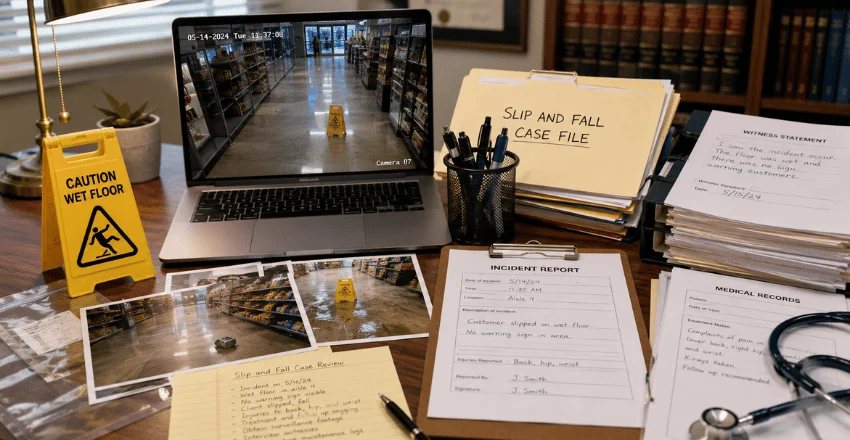
Bring these to every call. Write down the answers, then compare two firms on paper rather than on gut feeling.
- How many premises cases have you tried to verdict, and when was the last one?
- Is the contingency fee 33% or 40%, and what event moves it up?
- Do you calculate the fee on the gross settlement or after costs?
- Who advances case costs and expert fees, and do I repay them if we lose?
- Will your office keep my file, or does it go out for referral fees?
- Which states are you licensed in, and who covers me if my case crosses a state line?
- Who calls me back, and how fast?
Red flags that should end the call
- A guaranteed dollar figure on the first phone call.
- Pressure to sign before you have read the fee agreement.
- No written answer about who pays costs if you lose.
- An office that cannot name a single premises trial it has handled.
- A free consultation that turns into a hard sell for a clinic the firm owns.
Evidence disappears while you shop around
Grocery chains record on a loop.
Many systems overwrite surveillance video within 14 to 30 days, and some recycle it in a week. Your lawyer’s first move should be a spoliation letter ordering the property owner to preserve the video, the sweep logs, and the incident report. Miss that window and the case turns into your word against a manager’s memory.
Comparative negligence then shaves the rest. A jury that calls you 30 percent at fault turns a $100,000 verdict into $70,000.
Falls in care homes and rented buildings
Not every fall is a store fall. A resident who falls in a care facility brings staffing records, care plans, and state inspection reports into play, which is a different investigation entirely. Those files usually belong with a nursing home abuse attorney.
Falls in older adults are also getting deadlier. The CDC reports that the age-adjusted fall death rate climbed 21%, from 64.7 per 100,000 older adults in 2018 to 78.4 per 100,000 in 2024.
Landlord cases turn on repair notices and lease language instead. Ask any firm how many of those it has run, and listen for a specific building type rather than a category.
The verdict: which firm to hire

Here is the recommendation, stated plainly. Start with your bills. If they sit under $25,000 and the insurer has already conceded the hazard, a solo practitioner at 33% beats a national firm at 40%.
If a chain store denies knowing about the spill, hire the regional injury firm with previous verdicts on its record. Those lawyers have deposed the same risk managers before, and it shows in the offer.
Surgery, permanent restrictions, or a real fight over your share of fault? Go to the trial boutique and pay the 40 percent. You get a lawyer the insurer believes will actually try the case, and that belief is what moves money. Call two firms this week, ask the seven questions, and hire the one that answers in writing.
Frequently asked questions
Handle it yourself if liability is admitted and your bills run a few hundred dollars. Once you face a denial, a lien, or surgery, the numbers stop favoring self-representation.
Most states allow one to three years from the date of the fall. Claims against a city, county, or state agency can demand written notice within 90 days, which catches people out.
Clean claims often resolve in six to twelve months. After a lawsuit is filed, eighteen months to three years is normal, and a trial date can stretch it further.
Usually 33% before a lawsuit and 40% after. State bar rules require contingency agreements in writing, so ask for the document and read the costs clause twice.
No. Ad money buys intake volume, not trial results. The best slip and fall lawyer for you will name the premises’ verdicts they have won and put the fee math in writing before you sign.