
Two deadlines kill more inventions than any examiner ever will. The first begins the day you sell the invention, offer it for sale, or show it publicly, and it leaves you twelve months to file in the United States. The second is the twelve-month life of a provisional application, which expires on its own and takes your priority date with it. Knowing how to get a patent starts with protecting both deadlines before you move forward.
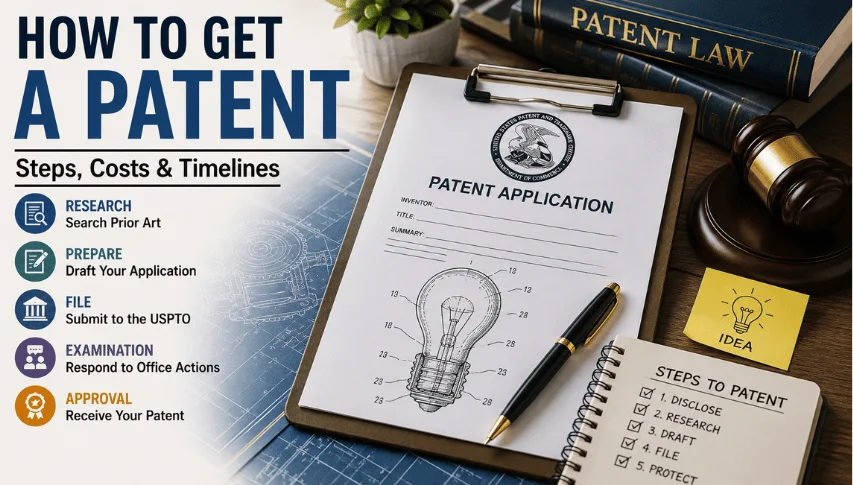
| How to Get a Patent | What It Involves | Key Cost/Deadline |
| Document the invention. | Record how the invention works, variations, and development details. | Date and sign records |
| Check the filing deadline. | Identify any sale, offer, publication, or public disclosure. | US grace period: generally 12 months |
| Search prior art. | Review existing patents, publications, products, and technical disclosures. | USPTO Patent Public Search |
| Choose application type. | Select provisional, utility, or design protection. | Provisional expires after 12 months. |
| Establish ownership. | Identify inventors and record assignments when applicable. | Ownership should be settled before filing. |
| Prepare the application. | Draft specification, claims, drawings, and required declarations | Professional drafting may cost thousands. |
| File with USPTO | Submit through the Patent Center and pay required fees. | Utility filing/search/examination fees apply. |
| Respond to the examination. | Address office actions through amendments or legal arguments. | May require multiple responses |
| Pay the issue fee. | Complete the final payment after allowance. | Notice of Allowance generally gives 3 months. |
| Maintain the patent. | Pay required maintenance fees for utility patents. | Due at 3.5, 7.5, and 11.5 years |
Key Takeaway
- Sell it or publish it, and your US filing window closes twelve months later. Most other countries give you no window at all.
- Provisionals cost $65 to $325 and die at twelve months. It is a placeholder, not protection.
- Budget roughly $400 to $2,000 in USPTO fees to file, plus attorney drafting costs that usually run several thousand dollars.
- Expect well over a year before an examiner first reads your file and two to three years before allowance.
- First rejections are normal. Most applications that were eventually issued were rejected at least once.
Three checks before you spend a dollar

Filing is cheap compared with drafting, and drafting is cheap compared with finding out you were never eligible. Three questions settle that, and all three have answers you can reach in an afternoon. Has the clock already started? Under US law, you get a one-year grace period after your own public disclosure, sale, or offer for sale. That grace period is generous by world standards. Europe and China, along with most of Asia, apply an absolute novelty rule, so a trade show demo in March can end your foreign rights immediately.
Is it the kind of thing that qualifies? Machines and processes qualify, as do compositions of matter and manufactured articles. Abstract ideas and natural phenomena do not, and neither does anything already described in a printed publication.
Who owns it? If you built it on an employer’s time or equipment, your employment contract probably assigns it to the company. Read the invention assignment clause before you file anything, and have an employment attorney review that clause if the wording is broad or ambiguous. Inventors have lost entire portfolios to a sentence they signed on day one.
Provisional, utility, or design: pick this first.
These three are not stages of one process. They are separate filings with separate costs, and picking the wrong one wastes a year. Start with the provisional application, which buys a filing date and nothing else. Nothing is examined, and nothing is published. It goes abandoned exactly twelve months after filing. You convert it by filing a nonprovisional within that window, or you lose the date. Filing a thin provisional is the classic mistake, because your later claims only get the early date for material the provisional described.
A utility application covers how something works, not how it looks. Examination is real here. The application publishes at eighteen months, and a granted utility patent runs twenty years from the filing date. Flip that for the design application, which covers how something looks. Drawings carry almost the whole filing. Examination is faster, and the term runs fifteen years from grant.
What it costs at the USPTO in 2026
Government fees changed in January 2025, and plenty of guides still quote the old numbers. Rates depend on your entity size. Micro entity status requires gross income under roughly three times the median household income and no more than four prior filings. Small entity status covers businesses under 500 employees, plus nonprofits and independent inventors.
According to the USPTO fee schedule effective January 19, 2025, the basic utility filing fee is $350 undiscounted, $140 for a small entity, and $70 for a micro entity. Search and examination fees are charged on top of that. Every line item sits in the full USPTO fee schedule. Here are the ones that apply to a first filing.
| Fee | Undiscounted | Small entity | Micro entity |
| Provisional filing | $325 | $130 | $65 |
| Utility basic filing | $350 | $140 | $70 |
| Utility search | $770 | $308 | $154 |
| Utility examination | $880 | $352 | $176 |
| Utility issue fee | $1,290 | $516 | $258 |
| Design basic filing. | $300 | $120 | $60 |
| Design search | $300 | $120 | $60 |
| Design examination | $700 | $280 | $140 |
| Design issue fee | $1,300 | $520 | $260 |
Add those three utility lines together, and a micro entity files for $400 in government fees, while an undiscounted applicant pays $2,000. Neither figure includes drafting, drawings, or the responses you will file later.
How to get a patent: the nine steps

- Write a dated invention disclosure. Describe what the invention does, how it works, and every variation you can think of, including the ones you rejected. Then sign and date it. This document becomes the raw material your drafter works from.
- Fix your filing deadline in writing. Find the earliest date you sold, offered, published, or publicly demonstrated the invention. Then add twelve months. That date now governs everything else you do.
- Search the prior art. Run your key terms and classification codes through Patent Public Search. Then check Google Scholar, trade press, product catalogs, and expired filings for disclosures that never became patents. You are looking for a reason to stop, not for reassurance.
- Choose the application type. Pick provisional, utility, or design using the section above, and write the conversion date on your calendar if you go provisional.
- Settle ownership and record the assignment. Name every true inventor, since a wrong inventor list can void the grant later. If a company owns the rights, execute an assignment and record it with the USPTO. Recording works much the way a deed does, and the diligence resembles a closing where a real estate attorney checks title before money moves.
- Draft the claims and drawings. Claims define the legal boundary, and everything else in the document exists to support them. Drawings must show every feature the claims mention. This is the step where self-filers most often destroy their own scope.
- File in Patent Center and pay the three fees. Register as an eFiler, then upload the specification, claims, abstract, and drawings, along with the inventor oath or declaration. Pay all three government fees together. You get a filing receipt with your application number the same day.
- Answer the office action. Expect a rejection or an objection, usually citing earlier references. You respond by amending claims, by arguing why the references differ, or by doing both. Calling the examiner for an interview often moves a stuck case faster than another written round.
- Pay the issue fee. Your Notice of Allowance gives you three months to pay, and that deadline cannot be extended for any reason. Pay it, and the grant issues a few weeks later.
How long the wait actually runs
Nobody warns first-time applicants how quiet the middle is. You file, you get a receipt, and then months pass with nothing at all in the mail. Queue length explains it. According to the USPTO FY 2025 Agency Financial Report, the unexamined application inventory stood at 788,229 at the close of the fiscal year. That was down 49,699 over twelve months. Roughly 8,000 examiners work through that pile.
In practice, a first office action on a utility case commonly arrives fourteen to twenty-two months after filing. The whole path from filing to grant usually runs two to three years. Crowded art areas such as software and biotech sit at the slow end. Design cases move faster because the examination is narrower. Track One prioritizes examination costs and targets a final decision within twelve months, which is the one reliable way to compress the schedule. Add the provisional year on the front, and a single case can span four years from disclosure to grant. Plan your product launch around that, not against it.
After the grant: what keeps it alive?
Utility rights are not permanent on their own. Maintenance fees fall due at three and a half years, again at seven and a half, and again at eleven and a half. They rise steeply each time. Skip one and the rights lapse into the public domain. Design patents carry no maintenance fees at all.
Enforcement is also yours to fund. A grant gives you the right, but stopping an infringer means a federal lawsuit or a license negotiation. Neither is cheap. Budget for that reality before you decide the grant is the finish line.
Do you need an attorney?

You can file for yourself. Independent inventors do it every year, and the USPTO runs a Pro Se Assistance Center and a Patent Pro Bono Program for inventors under an income threshold. Scope is the honest tradeoff. Self-drafted applications often issue with claims so narrow that a competitor designs around them in an afternoon.
That is worse than no filing at all, because you have published the idea and gained nothing. Only a USPTO-registered attorney or agent can prosecute the case for you, and drafting a utility application typically costs $5,000 to $15,000 depending on complexity. If the invention is the business, that number is insurance rather than overhead.
Conclusion
Getting a patent requires more than submitting an application. Inventors must protect their filing deadline, establish ownership, conduct a thorough prior-art search, select the right application type, and prepare claims that accurately define the invention. USPTO fees vary by entity size, while professional drafting and prosecution can add substantially to the total cost.
A provisional application can establish an early filing date, but it does not provide enforceable patent rights on its own. Careful preparation and timely responses throughout the examination process can help protect the invention and avoid costly mistakes.
Want to know about Marriage Visa Lawyer: Expert Guidance and Comprehensive Support for a Smooth and Successful Marriage Visa Application? Check out our Business Law category.
Your next step
Knowing how to get a patent matters less than knowing when your window shuts. Start with the date, not the paperwork. Write down the earliest day the invention left your control, then count twelve months forward and work backward from there. If that date is already close, talk to a registered practitioner this week rather than next month. Your filing date is the one thing here you cannot buy back.
FAQ
No. You need a specific, described, workable implementation. “An app that matches dog walkers” is an idea. The particular matching method, described so an engineer could build it, may be patentable.
For a micro entity filing a straightforward utility case with professional drafting, $6,000 to $10,000 through a grant is realistic. Complex cases with multiple office actions run higher.
It protects your date, nothing more. You cannot sue anyone on a provisional, and it evaporates at twelve months.
Rights acquired during a marriage can count as marital property in many states, so valuation questions often land in front of a family law attorney handling asset division. Assignment records matter here as much as the grant itself.
Its process overview and application basics pages set out the same sequence, and its Pro Se Assistance Center answers questions from inventors filing without counsel.