
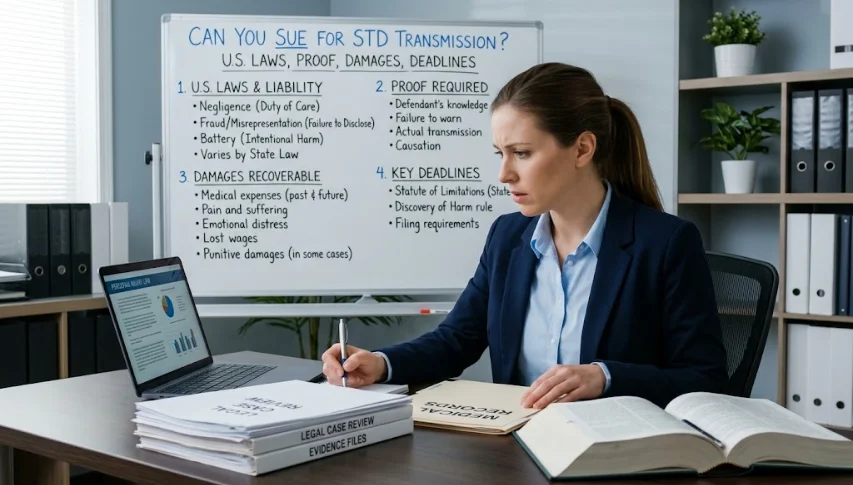
If you ask, “can you sue someone for giving you an STD,” the answer can be yes under U.S. law. Your rights depend heavily on your state, the infection, and what the other person knew. You must also prove that their conduct caused your infection and resulted in legally recognized harm.
Sexually transmitted infection cases usually proceed under ordinary civil claims rather than one nationwide statute. Negligence, fraud, battery, and emotional-distress claims may apply to different facts. Courts have allowed such claims in cases involving concealed or undisclosed infections.
Quick answer: A person who knowingly or negligently exposes a sexual partner to an infection may face civil liability. The strongest cases usually involve proof of prior knowledge, nondisclosure or deception, transmission, and measurable damages. State law controls the exact legal claim, filing deadline, defenses, and available compensation.
| Key issue | What usually matters |
|---|---|
| Legal basis | Negligence, fraud, battery, or another state tort |
| Knowledge | Whether the defendant knew or reasonably should have known |
| Disclosure | Whether the infection or transmission risk was disclosed |
| Causation | Whether evidence connects that person to your infection |
| Damages | Medical costs, lost income, pain, and emotional harm |
| Filing deadline | Set by state law and sometimes affected by discovery rules |
| Criminal law | Separate from a civil lawsuit and varies greatly by state |
Can You Sue Someone for Giving You an STD Under U.S. Law?
There is no single federal rule governing every private STI transmission lawsuit. State tort law usually determines whether a civil claim exists and what must be proven. The specific cause of action can change based on knowledge, deception, intent, and resulting harm.
California provides a well-known example of civil liability in this area. In Kathleen K. v. Robert B., a California appellate court allowed claims involving negligence, battery, emotional distress, and fraud to proceed. The plaintiff alleged that a sexual partner transmitted herpes after concealing or misrepresenting his condition.
A later California decision also recognized a duty connected with preventing transmission of a sexually transmitted infection. The court discussed negligence where a defendant knew about herpes yet failed to disclose it or prevent transmission. These cases illustrate possible claims, but they do not create one nationwide standard.
Which Legal Claims Can Apply?
Negligence is one of the most common theories in an infection lawsuit. A plaintiff generally must establish duty, breach, causation, and damages under applicable state law. LawViya explains how duty and breach work in its premises liability law guide. Knowledge often becomes a central dispute in a negligence claim. The defendant may have known through testing, symptoms, treatment, or a prior medical diagnosis. Some claims may also examine whether a reasonable person should have recognized a transmission risk.
Fraud or misrepresentation may apply when a person lies about their status or conceals important information. The plaintiff usually must show that the false statement mattered to their decision. Evidence of direct questions and false answers can be especially important.
Civil battery may also arise under some state laws and factual circumstances. The argument can focus on whether informed consent covered contact involving an undisclosed known infection risk. Courts do not apply this theory identically in every jurisdiction.
An emotional-distress claim may accompany another cause of action when state requirements are satisfied. These claims often require more than ordinary worry or disappointment. Severe distress normally needs credible evidence connecting it to the defendant’s conduct.
What Do You Have to Prove?
A diagnosis alone does not establish who transmitted an infection. A successful plaintiff generally needs evidence connecting the defendant, the exposure, and the resulting medical condition. This causation issue can become the hardest part of the case.
Useful evidence may include:
- Laboratory results and medical records showing diagnosis and treatment.
- Earlier negative tests that help establish a medical timeline.
- Text messages, emails, or messages discussing testing or infection status.
- Admissions showing that the other person knew about an infection.
- Evidence concerning the timing of sexual contact and symptoms.
- Witness testimony concerning relevant statements or disclosures.
- Medical opinions explaining transmission timing when medically supportable.
Circumstantial evidence can matter when direct proof is unavailable. Courts regularly consider indirect evidence in civil cases when it logically supports an element. LawViya’s guide to res ipsa loquitur explains one well-known form of circumstantial proof in negligence cases.
The defense can challenge alternative sources of transmission. Long incubation periods or asymptomatic infections may make that dispute harder to resolve. Medical evidence must support the timeline rather than rely on assumptions.
Does the Other Person Have to Know They Were Infected?
Knowledge often makes a claim stronger, but the required mental state depends on state law. Some negligence theories may examine what the defendant reasonably should have known. Fraud usually requires stronger evidence of knowledge and a false representation. A positive test before the relationship can provide direct evidence of prior knowledge. Treatment records or written admissions may also establish awareness. Access to private medical information remains subject to court procedures and privacy protections.
The issue can become difficult when someone never received a diagnosis. Many sexually transmitted infections can exist without noticeable symptoms. The CDC distinguishes an STI from a disease state and notes that infections can exist before recognizable disease develops.
Does Every State Require Disclosure?

Disclosure rules are not uniform across the United States. Some states have statutes addressing particular infections or circumstances. Other cases are handled primarily through civil negligence, fraud, battery, or public-health laws. Florida offers a clear statutory example. Its 2026 law prohibits certain people from having sexual intercourse without disclosure and consent when statutory conditions are satisfied. Those conditions include knowledge of the infection and information that it can be sexually transmitted.
Florida separately establishes criminal penalties for some violations of that public-health chapter. A criminal prosecution and a private civil lawsuit remain different proceedings. A person should therefore check current law in the state where the relevant events occurred.
What Damages Could You Recover?
Compensation depends on the harm you can document and your state’s damages rules. Medical bills and related treatment expenses are common categories. Lost wages may also be recoverable when the infection caused missed work. Pain, physical symptoms, and emotional distress can also form part of a damages claim. Long-term treatment needs may increase claimed losses when supported by medical evidence. Punitive damages may be available in some jurisdictions when conduct meets a heightened legal standard.
Do not assume that a serious diagnosis automatically produces a large award. Courts focus on provable losses, causation, and the governing state rules. LawViya’s malpractice lawyer guide shows how damages and evidence are handled in a related negligence-based claim.
Is Giving Someone an STI Also a Crime?
Civil liability and criminal responsibility are separate legal questions. A civil lawsuit generally seeks compensation from the defendant. A criminal case is brought by government prosecutors under applicable state law. Some states criminalize defined forms of knowing exposure or nondisclosure. The covered infections, required intent, defenses, and penalties differ considerably. Florida’s current statute demonstrates why nationwide statements about criminal liability can be misleading. A criminal conviction is not required before someone files a civil claim. Likewise, the existence of a civil claim does not prove a crime occurred. Each proceeding has different elements, procedures, and burdens of proof.
How Long Do You Have to File?
Every state imposes deadlines called statutes of limitation. The deadline may depend on whether the case alleges negligence, fraud, battery, or another tort. Different legal theories can therefore create different filing questions. The starting date can also become disputed. Some states apply discovery rules when an injury was not reasonably discoverable immediately. An infection that remains asymptomatic can make that issue especially important.
Waiting can also make evidence harder to preserve. Messages may disappear, witnesses may become unavailable, and medical timelines can become harder to reconstruct. Speak with a lawyer licensed in the relevant state before relying on a general deadline.
What Should You Do After Learning About an Infection?
First, obtain appropriate medical testing and treatment from a qualified healthcare professional. Keep copies of laboratory results, appointment records, prescriptions, and medical bills. Do not alter or delete communications that could later become evidence. Next, create a factual timeline while events remain fresh. Record relevant testing dates, sexual contact dates, disclosures, symptoms, and conversations. Keep the timeline private and avoid publishing accusations online. Finally, consider speaking with a personal injury attorney in your state. A lawyer can assess applicable claims, deadlines, evidence, and privacy concerns. Legal advice becomes especially important when the defendant disputes knowledge or causation.
Privacy Issues During an STI Lawsuit
Litigation can involve sensitive health information. Courts may allow relevant medical discovery while still applying procedural protections and privacy rules. The exact scope depends on the issues raised and the jurisdiction. Publicly sharing another person’s medical status can create separate legal problems. Claims involving privacy or disclosure may arise in some circumstances. Keep evidence for your lawyer rather than turning a private dispute into a public campaign.
In unusual cases, a person may need an order stopping continuing harmful conduct. LawViya explains how courts handle temporary and permanent injunctive relief. Whether that remedy fits an infection-related dispute depends on the specific threatened conduct.
The Bottom Line
Civil claims over sexually transmitted infections are possible in the United States, but state law controls the details. Strong cases usually require evidence of knowledge, nondisclosure or wrongdoing, causation, and measurable damages. No single rule determines liability for every infection or every relationship.
Medical records and preserved communications can become central evidence. Filing deadlines can also expire before every factual dispute is resolved. Getting state-specific advice early can protect both your claim and sensitive health information.
Frequently Asked Questions
Can you sue someone for giving you an STD if they say they did not know?
Possibly, because knowledge requirements depend on the legal theory and state law. A negligence claim may examine what someone knew or reasonably should have known. Fraud generally requires evidence supporting deliberate misrepresentation or concealment.
Can you sue if the infection was herpes?
Herpes has been the subject of recognized civil claims. California’s Kathleen K. decision involved allegations of genital herpes transmission and allowed several tort theories to proceed. Your state’s law and your evidence still control your individual case.
Can you sue if you cannot prove who infected you?
You can file a claim, but causation remains a required issue. Multiple possible sources can make proof significantly harder. Medical timing, testing history, communications, and admissions may help establish the necessary connection.
Do you need a criminal case first?
No, a civil claim generally does not depend on prosecutors filing criminal charges. Civil and criminal proceedings have different purposes and burdens. State law determines the elements required in each proceeding.
Is STI the same as STD?
The terms are often used interchangeably, but the CDC distinguishes them. An STI means an infection acquired through sexual contact. An STD describes a disease state that develops from an infection.