

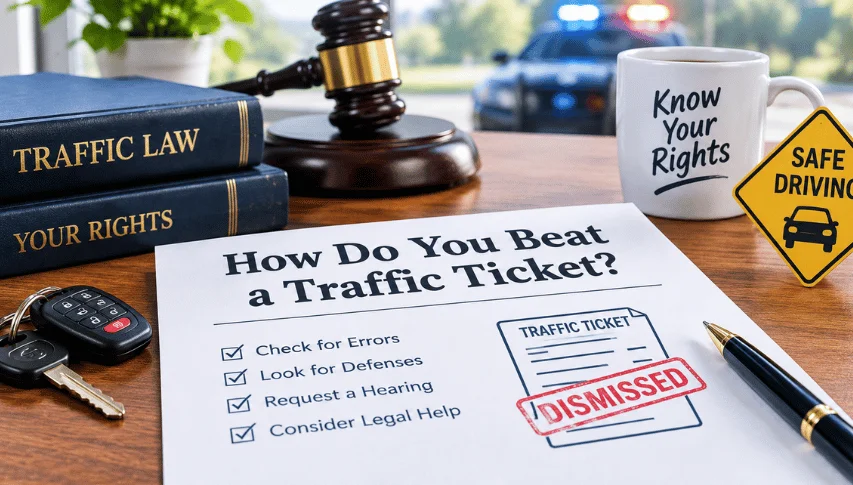
Getting cited does not automatically mean you must accept the charge. If you are wondering how do you beat a traffic ticket, start with the citation, applicable law, and available evidence. The exact procedure depends on the state and court handling your case.
Direct answer: You can contest a citation by responding before the deadline, pleading not guilty where appropriate, and identifying what the government must prove. Gather photographs, video, witnesses, records, and other admissible evidence. Then challenge unsupported elements or unreliable evidence using the procedures allowed by your court.
| Key issue | What to check |
|---|---|
| Response deadline | Date printed on the citation or court notice |
| Exact charge | Statute or vehicle code section listed |
| Available plea | Guilty, no contest, or not guilty options vary. |
| Evidence | Photos, video, witnesses, diagrams, records |
| Government evidence | Officer observations, radar, lidar, and camera records |
| Hearing method | In person, remote, or written where permitted |
| Possible outcomes | Dismissal, conviction, reduction, traffic school, or another disposition |
| Legal help | Consider counsel for serious charges or license risks. |
How Do You Beat a Traffic Ticket? Start With These 7 Steps
There is no universal trick that guarantees dismissal. A useful defense attacks a legal element, unreliable evidence, or a recognized factual issue. Your court’s rules determine which arguments, documents, and procedures are available.
1. Read the Citation Before Doing Anything Else
Check the alleged offense, code section, location, date, and response deadline. Then find the official text of the law you allegedly violated. Knowing the statute shows what facts the government must establish.
Do not assume a minor typo automatically defeats the case. Courts may permit correction of clerical errors under local rules. Focus instead on mistakes that affect identity, notice, evidence, or an element of the alleged offense. If the citation involves a DUI stop, Lawviya’s BK Attorney guide explains the testing rules that apply.
2. Decide Whether You Will Contest the Charge
Follow the instructions printed on your citation or official court notice. Courts may allow you to request a trial online, by mail, or in person. Missing the response deadline can create additional consequences.
California, for example, lets drivers ask for a trial (see the California Courts Self-Help traffic guide) when they dispute qualifying citations. New York City’s Traffic Violations Bureau lets eligible motorists plead not guilty and schedule a hearing. These examples show why nationwide advice cannot replace your local court’s instructions.
3. Gather Evidence While It Is Still Available
Return to the location safely and photograph signs, markings, sight lines, and relevant obstructions. Preserve dashcam recordings before the device overwrites them. Save witness contact information and other records connected with the incident.
A diagram can also clarify positions, distances, intersections, and visibility. Nolo identifies photographs, witness testimony, and diagrams as evidence that can support challenges to an officer’s observations. Evidence usually carries more weight than a simple disagreement about what happened.
4. Identify What the Government Must Prove
Every offense contains legal elements. The government must satisfy the applicable burden for the proceeding. Your defense should focus on an element that reliable evidence does not establish.
Suppose the citation alleges failure to obey a traffic-control device. Relevant questions might include whether the device was legally present and visible. Your state’s statute and cases determine the precise requirements.
Do not assume every traffic court uses the same burden of proof. California describes its traffic-trial standard as proof beyond a reasonable doubt. New York’s TVB states that its administrative hearings use clear and convincing evidence.
5. Examine the Officer’s Observations and Measurement Evidence
An officer’s position can matter in an observation-based case. Buildings, traffic, distance, darkness, weather, or other conditions may affect what the officer could see. Photographs and diagrams can make those limitations easier for a judge to understand.
Speed cases may involve radar, lidar, or pacing. Device requirements and evidentiary foundations vary by jurisdiction. Check whether local rules allow requests for calibration, maintenance, certification, notes, or related records.
Do not argue that speed-measuring technology is unreliable in general. Connect your challenge to the device, operation, documentation, or circumstances in your case. Specific evidence creates a stronger factual argument than speculation.
6. Prepare a Short, Evidence-Based Court Presentation
Organize your case around the disputed legal issue. Bring copies of permitted exhibits and arrange them in the order you expect to discuss them. Follow local filing and evidence rules before assuming a document will be accepted.
When questioning an officer, focus on facts that matter to the charge. Ask concise questions about position, visibility, observations, equipment, or other relevant matters. Avoid turning cross-examination into an argument with the witness.
Your own presentation should be equally focused. Explain what happened, identify your supporting evidence, and connect it to the disputed element. New York’s TVB confirms that motorists may testify, question the officer, call witnesses, and present evidence at qualifying hearings.
7. Consider Alternatives to a Full Trial
Dismissal is not the only useful result available in some jurisdictions. Traffic school, amended charges, corrected violations, or negotiated resolutions may reduce consequences. Eligibility and effects depend on state and local rules.
California courts, for example, provide procedures for correcting certain fix-it violations. Eligible California drivers may also use traffic school under specified circumstances. Neither option should be assumed to be available elsewhere.
A negotiated outcome can also make sense when the government’s evidence is strong. Ask what happens to points, fines, insurance reporting, and your driving record before accepting an offer. Those consequences can matter more than the face amount of the fine.
Defenses That May Work in the Right Case
A mistake of fact can matter when circumstances reasonably prevented compliance. An obscured sign after storm damage provides a common illustration. Ignorance of the law itself generally presents a different issue and usually is not enough.
Necessity can also arise in unusual situations involving immediate danger. A driver might cross a prohibited line to avoid striking a pedestrian. Whether that defense applies depends on the facts and governing state law.
Evidence can also undermine the officer’s account. Video, photographs, witnesses, or reliable records may contradict an observation or measurement. The key is connecting that proof directly to an element of the charge.
What Usually Does Not Make a Strong Defense
Saying the officer is wrong without supporting evidence is usually weak. The same problem applies to broad claims that radar equipment sometimes makes mistakes. A useful challenge explains why the evidence in your specific case is unreliable.
Being unfamiliar with the law usually does not excuse a violation. Driving with surrounding traffic also does not automatically create a defense. Your argument should address the statute and the evidence rather than fairness alone.
Do not depend entirely on the officer missing court. Procedures differ, and a judge may have options other than immediate dismissal. Prepare your substantive defense even when attendance by a particular witness could affect the proceeding.
Can You Fight the Citation Without Going to Court?
Some jurisdictions permit written proceedings for qualifying infractions. California courts, for example, offer trial by written declaration for certain traffic matters. Other courts may provide remote hearings or different procedures.
Written proceedings require the same attention to evidence and legal issues. Explain the relevant facts clearly and attach permitted supporting materials. Confirm filing requirements and deadlines with the court before relying on this option.
When Should You Consider a Lawyer?
Minor infractions can often be handled without counsel. Professional advice becomes more important when license suspension, several citations, commercial driving privileges, or serious penalties are involved. Criminal allegations deserve particular care.
DUI, reckless driving, hit-and-run, and similar charges may be criminal rather than ordinary infractions. Lawviya’s implied-consent guide explains related DUI testing rules and constitutional limits. Serious charges may also warrant reviewing the site’s criminal-defense resources before deciding how to proceed.
A crash connected with the citation can create separate civil issues. The ticket proceeding and an injury claim do not necessarily resolve the same legal questions. Lawviya’s car accident attorney guide explains representation considerations for accident claims.
Frequently Asked Questions
What is the best way to beat a traffic ticket?
The strongest approach depends on the statute, evidence, and local procedure. Start by identifying what must be proven and gathering evidence relevant to those elements. Avoid relying on excuses or generic technical arguments.
Does a mistake on the citation automatically get it dismissed?
Not necessarily. The effect of an error depends on what is wrong and the applicable procedural rules. A minor clerical mistake may be treated differently from an error affecting the charge or defendant.
Can photos or dashcam footage help?
Yes, relevant photographs or video can support your version of events. They may show visibility, signage, road conditions, vehicle positions, or other important facts. Preserve original files and follow your court’s evidence rules.
Can you challenge radar or lidar evidence?
Potentially, but the legal requirements differ between jurisdictions. Relevant issues can include operation, maintenance, calibration, identification, and the surrounding conditions. A specific evidence-based challenge is stronger than claiming all speed devices are inaccurate.
What happens if the officer does not appear?
The result depends on the jurisdiction and circumstances. Some courts may dismiss a case, while other procedures or outcomes may apply. Do not build your entire defense around a possible absence.
Is paying the citation the same as fighting it?
No. Payment commonly resolves the charge rather than contesting the allegations. Check the citation and official court instructions before paying if you intend to dispute it.
The Bottom Line
Beating a citation usually requires preparation rather than a courtroom trick. Read the charge, meet every deadline, understand the statute, and preserve relevant evidence. Then present the narrowest factual or legal issue that genuinely supports your position.
Because traffic procedure varies across the United States, confirm every step with the court handling your case. Consider local legal advice when the citation threatens your license or involves criminal allegations. Lawviya’s broader U.S. legal guidance can provide background before you seek case-specific advice.