
How Big Is 50 Acres? This question is especially important for landowners, developers, farmers, and conservation planners who need a clear understanding of large land measurements. Acres are commonly used to describe land size, but visualizing a large area like 50 acres can be challenging without proper context.
Whether the land is intended for residential development, agriculture, commercial use, recreation, or conservation, understanding the dimensions, real-world comparisons, potential uses, benefits, and challenges of 50 acres helps in making informed and strategic decisions.
With thoughtful planning, this amount of land offers significant flexibility, long-term value, and opportunities for sustainable growth.
| Aspect | Overview |
| How Big Is 50 Acres? | 2,178,000 square feet |
| Shape Examples | Square or rectangular |
| Visualization | Fields, blocks, parks |
| Real-World Use | Homes, farms, wildlife |
| Development Options | Residential, commercial |
| Recreational Use | Parks, sports facilities |
| Conservation Role | Habitats, preserves |
| Ownership Benefits | Investment, flexibility |
| Management Challenges | Zoning, maintenance |
Understanding 50 Acres
Acres are a common unit of measurement used primarily in the context of land, making them crucial for real estate, agriculture, and development. While many can envision a single acre, visualizing larger tracts of land, such as 50 acres, requires a more nuanced understanding.
Dimensions of 50 Acres
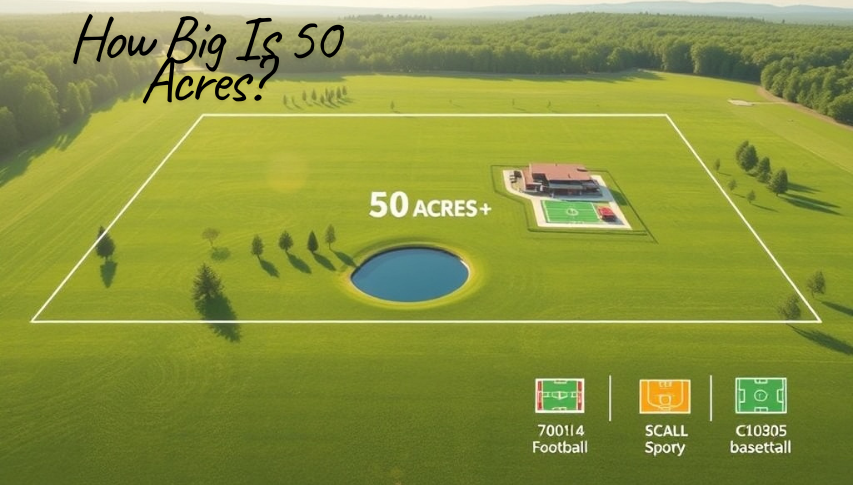
An acre is equivalent to 43,560 square feet, so 50 acres amounts to roughly 2,178,000 square feet of land. To visualize this area in different shapes, consider the following:
- Rectangular Dimensions:
- 1,320 feet by 660 feet
- 1,050 feet by 1,002 feet
- Square Dimensions:
- Approximately 447.2 feet on each side (as a perfect square).
These dimensions can help understand how a piece of land might be laid out, whether for residential, agricultural, or commercial purposes.
Visualizing with Landmarks
To provide a clearer picture, here are examples of familiar locations that approximate 50 acres:
- Football Fields: An American football field measures about 1.32 acres, so 50 acres could comfortably hold around 38 football fields.
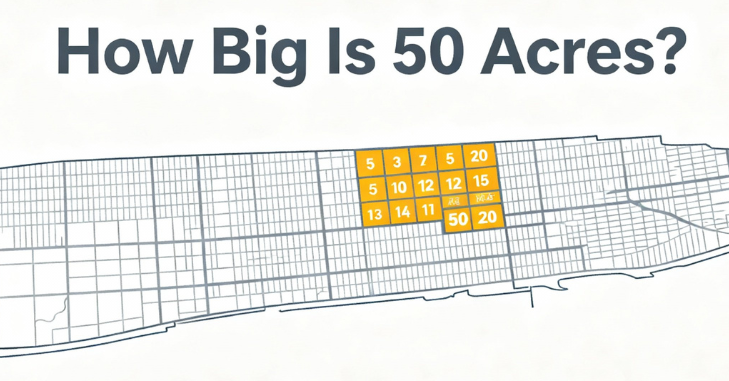
- City Blocks: In urban settings, a typical city block might measure around 2.5 acres. Therefore, 50 acres could cover approximately 20 city blocks.
- Parks: Many local parks vary in size, but 50 acres is comparable to larger community parks, providing ample space for recreational activities.
Real-World Comparisons
Understanding the size of 50 acres can be made easier by comparing it to familiar places or concepts. Here are additional comparisons:
Residential Developments
A residential community or a suburban development often utilizes land sizes ranging from 5 to 50 acres. For instance, a neighborhood might spread over 50 acres, featuring:
- Approximately 200 homes if the average lot size is 0.25 acres.
- Parks, playgrounds, and amenities are interspersed throughout the land.
Farms
50 acres of farmland can represent a medium-sized farm, suitable for various agricultural activities. The land could be used for:
- Crop production: A farm might grow corn, soybeans, or vegetables on this size.
- Livestock: Alternatively, it can support a small herd of cattle, sheep, or goats.
Wildlife Habitats
Many wildlife refuges and conservation areas encompass hundreds of acres, but smaller reserves of around 50 acres can make a significant impact on local ecosystems. This land could be used for:
- Protecting native species and their habitats.
- Implementing community education programs about local wildlife preservation.
Common Uses of 50 Acres

The potential uses of 50 acres are diverse and can serve various purposes, depending on the location and surrounding infrastructure. Here are some common applications:
Residential Development
With proper zoning, developers can create a residential community on 50 acres, incorporating homes, parks, and shared amenities. This setup can:
- Provide housing in suburban areas.
- Enhance community engagement through local activities.
Agricultural Use
Agriculture remains one of the primary functions of large tracts of land. Farmers can use 50 acres for:
- Crop Cultivation: Sustainable farming practices can yield significant crops to supply markets.
- Livestock Management: The space can accommodate grazing livestock or poultry.
Commercial Ventures
Real estate developers might consider this size ideal for:
- Retail Centers: 50 acres could host shopping malls, supermarkets, and restaurants.
- Industrial Parks: Warehouses and manufacturing facilities can utilize this land to optimize logistics and distribution.
Recreational Use
If the land is near urban centers, it can serve as a recreational space, offering:
- Parks: Creating walking trails, picnic areas, and playgrounds for community use.
- Sport Facilities: Combining soccer fields, baseball diamonds, or even a golf course.
Conservation Projects
With a growing emphasis on sustainability, 50 acres can serve conservation efforts:
- Establishing preserves: Protecting existing ecosystems, restoring native flora, and providing a wildlife sanctuary.
- Education centers: Hosting workshops and activities that educate the community about nature conservation.
Challenges of Managing 50 Acres
While the opportunities for utilizing land are plentiful, some challenges come with managing 50 acres effectively. Here are some potential hurdles:
Zoning Regulations
Different areas have varying zoning laws that dictate what can be built or utilized. When planning for residential or commercial development, navigating these regulations can be complex.
Environmental Concerns
Land management practices must consider environmental impacts. Questions about soil quality, water resources, and wildlife habitats arise, demanding thoughtful planning.
Maintenance Costs
Owning and maintaining a large piece of land can incur considerable costs. Owners need to budget for:
- Landscaping and maintenance
- Utilities and infrastructure development
- Taxes and insurance
Community Engagement
For development projects, collaboration with local communities can be crucial. Engaging stakeholders and ensuring their voice is heard might add time and complexity to the project.
Benefits of Owning 50 Acres
Despite challenges, owning or managing 50 acres provides numerous benefits, including:
Investment Opportunities
Investing in land can yield long-term financial benefits. As populations grow and urban areas expand, the value of land can appreciate significantly, presenting a solid investment opportunity.
Space for Development
Owning 50 acres allows for diverse developmental projects, whether residential, commercial, or agricultural. It provides ample space to tailor projects to meet market demands.
Quality of Life
For those looking to escape the hustle and bustle of urban living, 50 acres can provide a tranquil retreat. This land can facilitate:
- Outdoor activities: Hiking, horseback riding, or farming.
- Personal space: A large property fosters privacy and a sense of community.
Environmental Stewardship
Landowners can participate in environmental conservation initiatives aimed at restoring or preserving ecosystems. This promotes sustainability and fosters a relationship with nature.
Innovative Uses and Developments
As society evolves, innovative approaches to land use have emerged. Here’s a look at some creative ideas for how 50 acres can be utilized:
Sustainable Farming Practices
Sustainable agriculture emphasizes environmentally-friendly practices. Utilizing 50 acres for:
- Organic farming: Growing crops without synthetic pesticides or fertilizers.
- Permaculture: Designing land use that mimics natural ecosystems.
Eco-Tourism
With growing interest in eco-friendly tourism, 50 acres can host attractions like:
- Cabins or yurts for visitors looking to experience nature.
- Outdoor education programs that highlight local ecosystems.
Mixed-Use Developments
Combining residential and commercial uses is a growing trend. A well-designed mixed-use space on 50 acres could feature:
- Apartments or townhomes above shops.
- Recreation areas that enhance community engagement.
Community Gardens
Community gardens promote both sustainability and communal engagement. Fifty acres can provide:
- Urban farming opportunities.
- Space for locals to grow produce and learn about gardening.
Conclusion
Understanding the dimensions and potential uses of 50 acres offers valuable insights for landowners, developers, farmers, and conservationists alike. From residential developments to agricultural pursuits and innovative communities, 50 acres can serve many purposes depending on the surrounding environment and needs.
In a world where land is a finite resource, maximizing its use while balancing personal, economic, and environmental priorities is essential. Whether for investment, personal fulfillment, or community development, understanding the implications of owning or managing 50 acres can empower decision-making and foster sustainable practices.
This land offers limitless possibilities for creativity and functionality, making it a valuable asset in various contexts. By embracing innovative ideas and thoughtful planning, stakeholders can ensure that 50 acres serves as a foundation for growth and positive change.
Want to know about How Big Is 500 Square Feet? All About Visualizing 500 Square Feet, Room Size Breakdown, Common Uses of 500 Square Feet, And Much More Check out our Real Estates category.
FAQs
One acre equals 43,560 square feet, so 50 acres totals 2,178,000 square feet (50 × 43,560). If this land were shaped as a perfect square, each side would measure approximately 1,475.8 feet. The total perimeter would therefore be 4 × 1,475.8 = 5,903 feet, which is slightly more than one mile.
A 50-acre homestead layout provides ample space to support a wide range of agricultural activities, including a large orchard with approximately 300 fruit trees, 110 raised garden beds (4×8 feet), 55 ground-level garden plots (10×10 feet), and 55 beehives. In addition, the land can comfortably accommodate 125 pigs, 155 goats, 200 ducks, 225 chickens, and 12 cows, making it well-suited for diverse and sustainable farming operations.
A land measurement unit that equals 43,560 square feet or 4,840 square yards.
A killa (or acre) is traditionally measured as a rectangular area, calculated as 36 karams (198 feet) by 40 karams (220 feet), which equals 43,560 square feet. Approximately one-fifth of a killa or acre is referred to as a bigha.